PERSNET
PERsistent Structures in Neural NETworks:
Topological and Statistical Approaches to Enhance Deep Learning
Preview
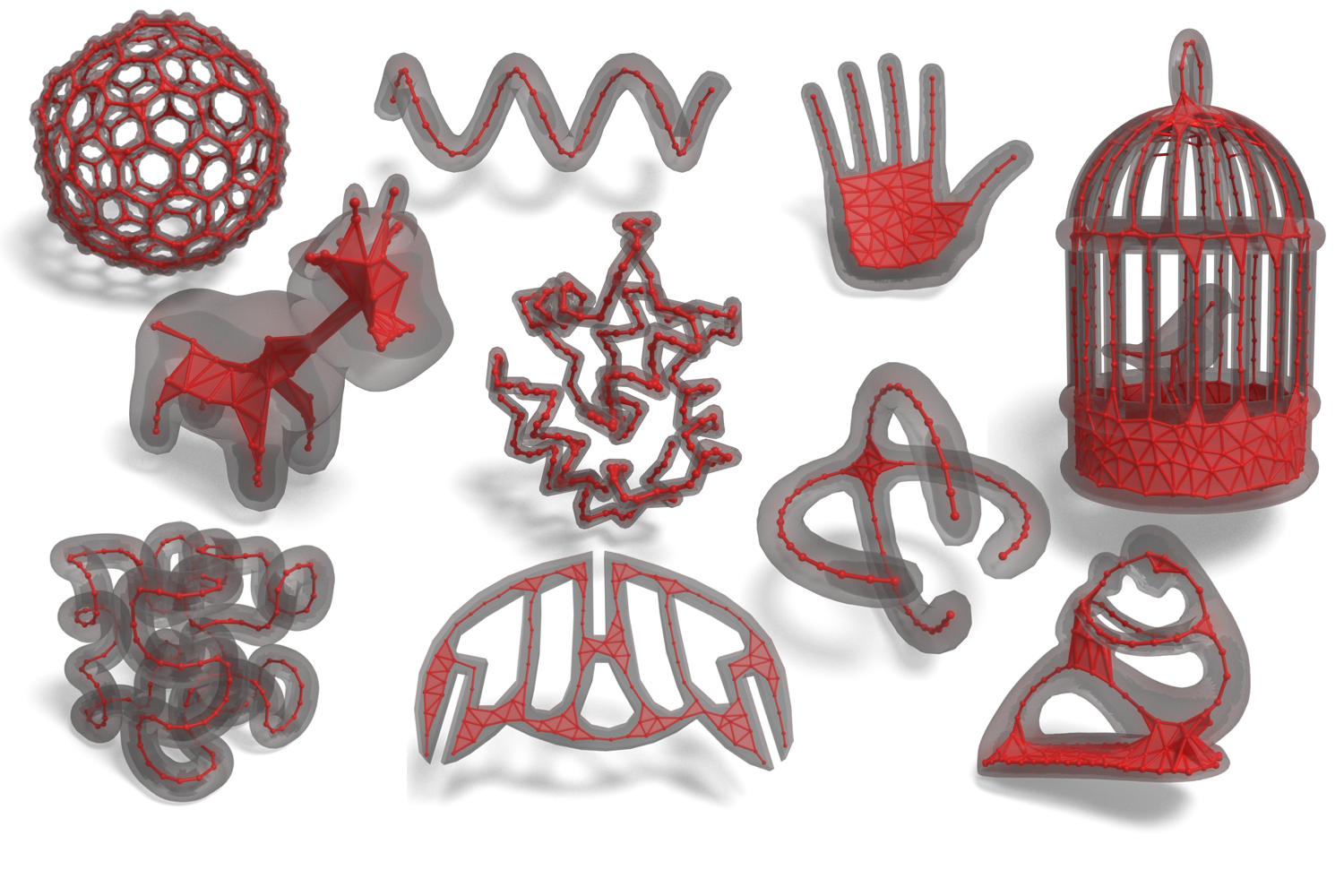
The unifying vision of this project is to leverage the interacting fields of Geometrical and Topological Data Analysis and High-Dimensional Statistics to enhance the design, analysis, and monitoring of Deep Neural Network (DNN) architectures.
Gilles Blanchard, Institut de Mathématiques d’Orsay, Université Paris-Saclay
The PERSNET project aims to create new methods and enhancements for DNNs based on topology, geometry, and statistics, in particular in order to monitor deep architectures, regularize or compress them, and take into account their graph connectivity and invariances.
Key words : Geometry, Deep Learning, Transformers, Topological data analysis, high-dimensional statistics
Missions
Our research
Develop fundamental mathematical tools (topological and geometric data analysis, statistics) towards deep learning
We will focus on advancing both theoretical and methodological foundations, driven by key challenges emerging from deep learning. It emphasizes developments in multiparameter topological data analysis, including the MAPPER algorithm, as well as topology-based regularization techniques and high-dimensional empirical Bayes methods
Use these tools to improve deep learning architectures for complex data, using geometric and topological descriptors.
We aim to develop principled topological and geometric descriptors for the analysis of complex non-Euclidean data, with a view toward their seamless integration into deep learning architectures. Key directions include the representation of persistence diagrams within kernel-based frameworks, the use of quantization techniques, and the characterization of geometric invariants of point clouds through the formalism of discrete measured metric spaces
Use these tools to analyze and monitor deep learning architectures themselves (purposes: efficiency, reliability, explainability, anomaly detection).
We will leverage, on the one hand, the developed topological descriptors, and on the other, insights from the geometry of the network path space, to monitor the intrinsic geometry of neural networks themselves, with the goal of improving their regularization, compression, and sparsity. We further aim to draw on high-dimensional statistical perspectives to analyze and optimize transformer architectures
Consortium
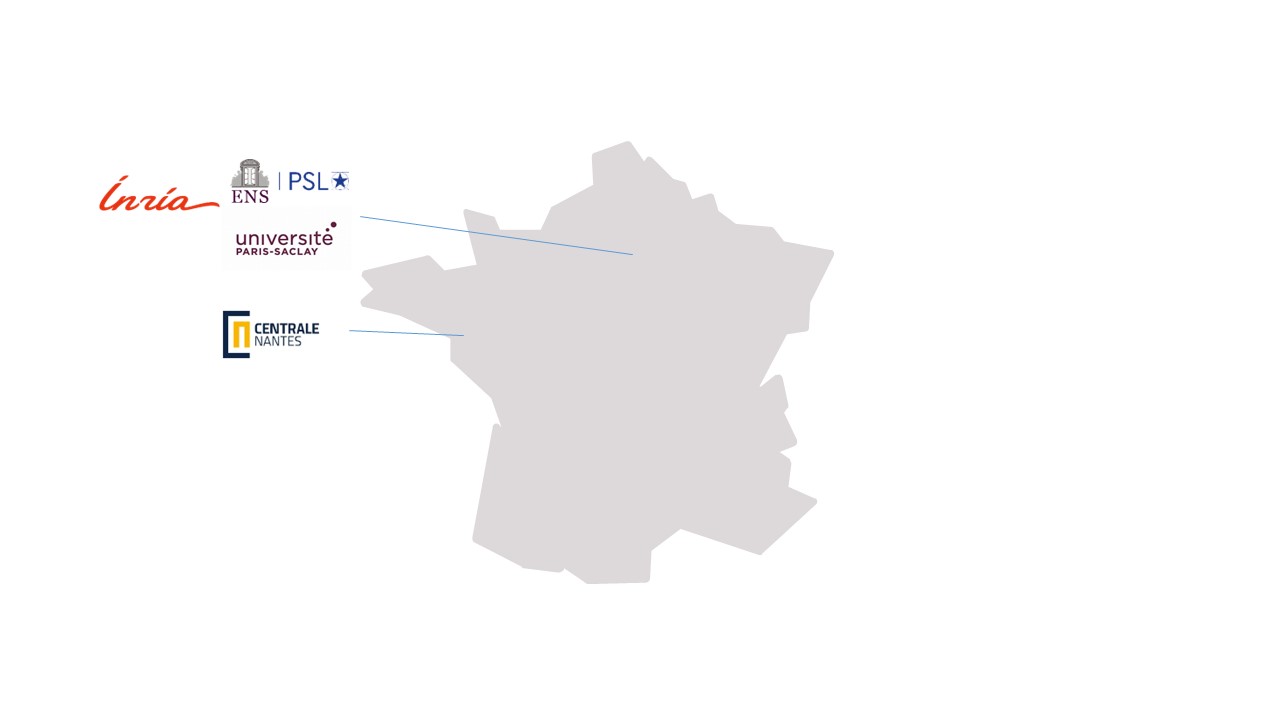
Université Paris-Saclay, Inria, Paris Sciences Lettres, Ecole Centrale de Nantes
- Publications in international scientific venues
- Software output in open-source libraries (eg. GUDHI)
- Integration/outreach towards industrial applications
Ultimately, the project’s contributions for Deep Learning architectures aim at improving:
- Efficiency (network compression) → greener/more portable AI
- Reliability / anomaly detection /explainability (network monitoring) → improve trust in AI
- Application to complex-structured data → applications for industry and in scientific research
A community of 12 researchers, research professors, and permanent engineers, also involving three doctoral students and two postdoctoral researchers as the project progresses.
Publication
Autres projets