THEOREM
Theory for more efficient generative models
Preview
Towards a better understanding of generative models in order to guide their adjustment, specialization, and fairness, thanks to a unified mathematical framework based on stochastic optimal control.
Alain Oliviero Durmus, Professor, Ecole polytechnique
Generative models have transformed the generation of images, texts, and scientific structures, but their design often remains empirical and difficult to control.
The THEOREM project proposes to “start from scratch” by developing a unified mathematical framework to explain what makes these models perform well and what causes them to fail (instability, bias, memorization, lack of robustness).
The goal is to translate practical recipes (schedules, time steps, choice of objectives) into design principles, with guarantees of stability and accuracy.
The project also aims to better understand how to adapt a model to a task or domain (specialization), while monitoring reliability and fairness.
Finally, the goal is to move from “artisanal” generative AI to more auditable and accountable generative AI.
Keywords: generative models, diffusion models, normalizing flows, energy-based models, stochastic optimal control, stability, convergence, fine-tuning, specialization, robustness, fairness, uncertainty, bias, AI for science.
Missions
Our researches
Unify generative models in a common language
Propose a theoretical framework that links diffusion and flows via a stochastic optimal control formulation, in order to compare, explain, and combine approaches in a consistent manner.
Transforming heuristics into a method
Derive design rules for key choices (training objectives, schedules, discretization, solvers) and establish practical criteria to guide fine-tuning.
Ensuring and diagnosing reliability
Develop analytical tools and safeguards (stability, errors, sensitivity) to understand when a model goes off track, why, and how to correct it in a robust manner.
Making specialization safer and more effective
Study specialization strategies (adaptation to a domain, a type of data, a physical constraint) while controlling generalization, uncertainty, and the risks of overfitting/memorization.
Putting equity at the heart of generative engineering
Analyze how biases arise and propagate in training and sampling, and propose regularization/diagnostic mechanisms to improve fairness without sacrificing quality.
Consortium
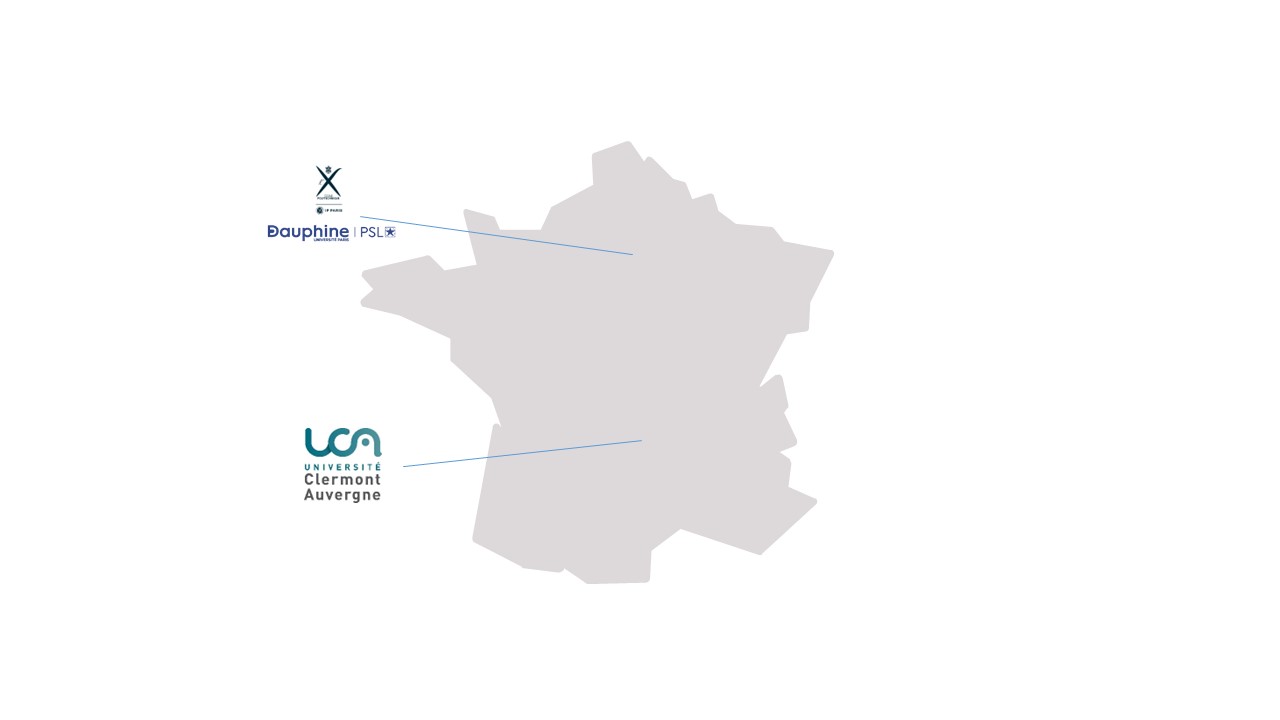
Université Clermont Auvergne, Université Paris Dauphine, Ecole Polytechnique de Paris
A unified theoretical framework (diffusion/flows/EBM) explaining the performance and limitations of generative models, with clear links between learning, generation, and control.
Guarantees and analysis tools (stability, convergence, error bounds, sensitivity) useful for designing and comparing generation algorithms.
Concrete design principles for fine-tuning and specialization (choice of schedules/solvers/objectives) to reduce reliance on trial and error.
Methods and diagnostics for reliability/fairness: uncertainty quantification, memorization detection, and recommendations to limit bias and undesirable behavior.
More reliable and transparent generative models: less “black box,” more diagnostics, and better-justified algorithmic choices—a key issue for trust and accountability.
Better risk management: bias, hallucinations, sensitive data memorization, instabilities—with tools to detect and reduce these problems.
A lever for AI in the service of science: more robust models for scientific discovery (chemistry, biology, physics, climate), where quality and consistency matter as much as raw performance.
Greater efficiency and simplicity: by reducing empirical tuning and testing cycles, the project can contribute to more reproducible and potentially less computationally costly pipelines.
A community of several researchers, teaching researchers, and permanent engineers, also involving four doctoral students and one postdoctoral researcher as the project progresses.
Publication
Autres projets